
Signs Your Roof Has Hidden Storm Damage (And When to Call a Pro)
November 2, 2026
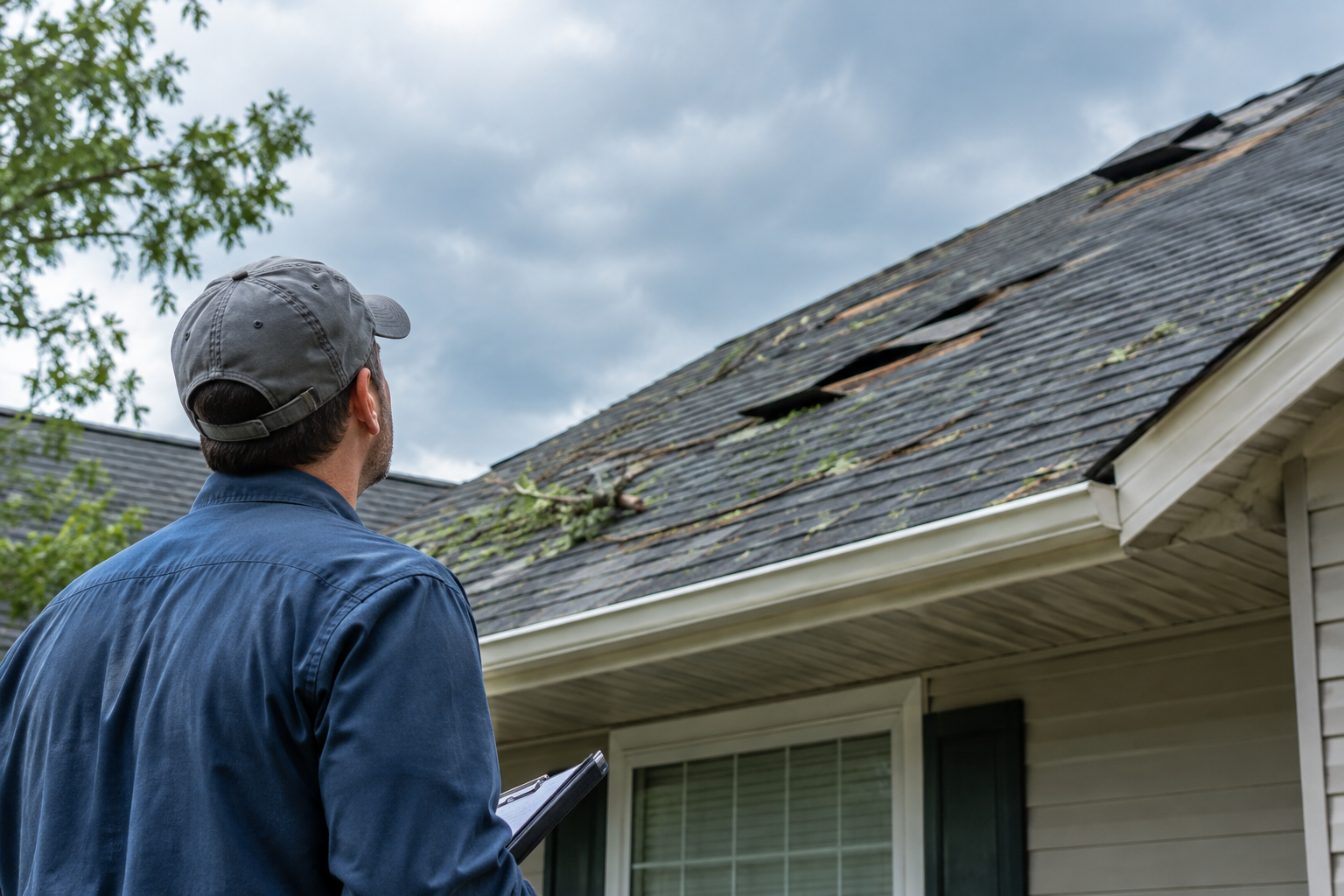
Most storm damage never shows up as a dripping ceiling. A 50 mph gust can break the factory sealant bond under a row of shingles without tearing a single one loose, and the roof keeps looking fine from the driveway for a year or more. The signs your roof has hidden storm damage are usually small, scattered clues: granules in a downspout, a bent vent cap, a faint circular bruise on a shingle you only notice up close.
Knowing what those clues look like matters, because most homeowner policies give you a limited window (often one year from the date of loss) to file a claim.
Why Storm Damage Stays Invisible for Months
Asphalt shingles protect your home through two systems: the granule surface that blocks UV, and the adhesive strip that glues each course to the one below it. Wind attacks the adhesive. Hail attacks the granules and the mat underneath.
Neither failure creates an immediate leak. A shingle with a broken seal still lies flat on a calm day, and a hail-bruised shingle still sheds water until the exposed asphalt dries out and cracks. That delay is why a roof that survived a July thunderstorm starts leaking the following February, after freeze-thaw cycles and ice have worked on the weak spots.
The Insurance Institute for Business & Home Safety has documented this gap between damage and failure in its field research on wind and hail performance, which is exactly why post-storm inspections matter more than post-leak repairs.
Ground-Level Signs You Can Check Safely
You do not need a ladder to catch most early warnings. Walk the full perimeter of the house with binoculars, ideally in low-angle morning or late-afternoon light when shadows reveal lifted edges.
- Shingles that look slightly out of line, with one course sitting a quarter inch higher than its neighbors, usually means a broken seal underneath.
- Dark patches or streaks where granules have washed away, often concentrated on the slope that faced the storm.
- Missing shingles or exposed nail heads anywhere on the field, plus torn tabs along ridges and hips where wind pressure is highest.
- Dented or dinged soft metal: gutter aprons, drip edge, vent hoods, furnace flashing and aluminum fascia dent before shingles show visible hail marks.
- Debris on the roof or in the yard, including branches heavy enough to have bounced across the slope before landing.
Shingle granules collecting at the base of a downspout tell you something too. A handful after a new roof’s first rain is normal; a cup or more from a roof over five years old is worth a professional look.
What Your Gutters and Attic Can Tell You
Gutters catch the evidence the roof sheds. Check them for granule sludge, dents on the outer face, loose hangers, and sections pulled away from the fascia by ice or wind. Damaged gutters also set up the conditions for winter problems, which is why it pays to address ice dam risk before the first hard freeze.
The attic is the single most useful place to read a roof from the inside. Go up on a bright day, turn off your flashlight, and look for pinpoints of daylight at the sheathing seams or around penetrations. Then switch the light back on and scan for these:
- Dark rings or water staining around nails, vent boots and chimney flashing
- Damp or compressed insulation, which holds moisture long after the deck dries
- Rust on nail shanks or metal strapping
- A musty smell, the earliest sign of slow moisture intrusion
- Sagging or spongy sheathing between rafters
Hail and Wind Leave Different Fingerprints
Hail damage shows up as random, circular bruises roughly a quarter inch to an inch across, often with granules knocked clear and a soft spot you can feel with a thumb. The pattern is scattered, not linear, and it appears on all slopes that faced the sky during the storm.
Wind damage is directional. You see creased shingles with a horizontal fold line, lifted tabs along the eaves and rakes, and failures clustered on the windward slope. Ridge caps and the first three courses above the eave take the worst of it.
Debris impact is a third category and the easiest to miss, because a branch can puncture the mat and leave a dime-sized hole hidden under the overlapping tab above it.
When to Stop Inspecting and Call a Roofer
Call a professional within a week of the storm if you see any of the following, rather than waiting for a leak to confirm it.
- Any missing or creased shingles. Where one has failed, the seal on the surrounding shingles is usually compromised too.
- Dents in gutters, vents or flashing. If hail was hard enough to dent aluminum, it was hard enough to bruise asphalt.
- Daylight or fresh staining in the attic. That is active water intrusion, and the deck is already involved.
- Recorded hail of one inch or larger in your area, which you can verify through NOAA’s Storm Events Database.
- Wind gusts above 55 mph paired with a roof older than 12 years.
Homeowners across Bucks and Montgomery counties deal with this cycle every spring and late summer. Our teams handle post-storm assessments for homeowners in Chalfont, PA where mature tree cover adds debris impact to the usual wind and hail mix.
What a Real Post-Storm Inspection Includes
A thorough inspection takes 45 to 90 minutes on an average home and produces photo documentation you can hand to an adjuster. The roofer should walk the roof where it is safe to do so, chalk-mark hail strikes in a test square, check all flashing and penetrations, examine the attic, and note the date of loss.
Be cautious with crews that knock on doors days after a storm, quote a replacement from the ground, or ask you to sign a contingency agreement before anyone has climbed a ladder. Reviewing what separates an established roofer from a storm chaser is worth ten minutes before you sign anything in 2026.
Schedule a Post-Storm Roof Inspection
If a storm has rolled through your area in the last year and nobody has looked closely at your roof since, Joe Kontz can document the condition before a hidden problem turns into interior repairs. Contact our team to set up an inspection and get a written assessment with photos.