
Why Proper Gutter and Downspout Integration Prevents Foundation Rot
November 10, 2026
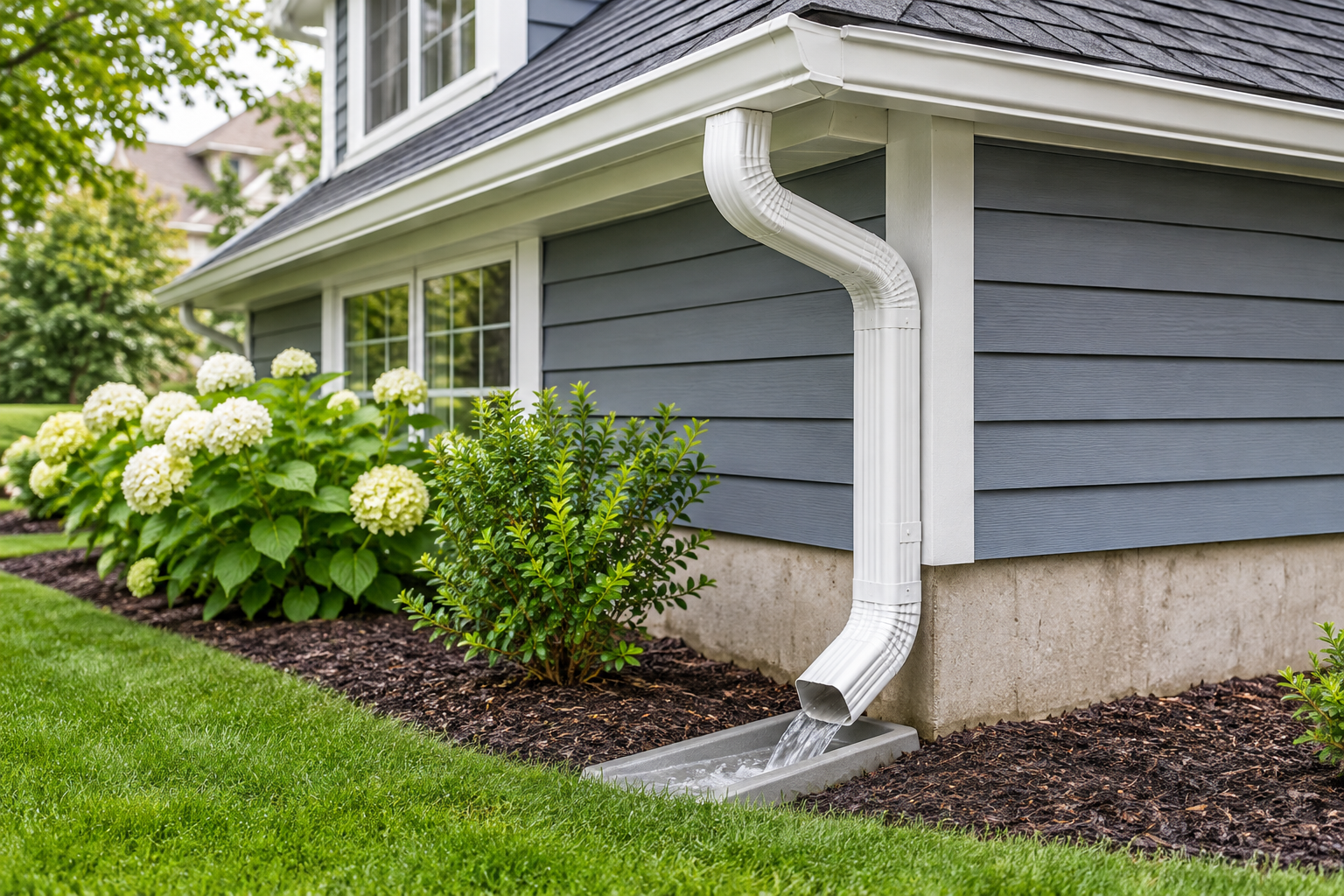
Proper gutter and downspout integration prevents foundation rot by capturing roof runoff and discharging it 6 to 10 feet away from the house, so water never saturates the soil against your footing. Saturated soil pushes against foundation walls, wicks moisture into sill plates and framing, and keeps wood damp long enough for decay fungi to take hold.
What Foundation Rot Actually Is
Foundation rot is the decay of wood framing members that sit on or near the foundation, mainly the sill plate, rim joist, and bottom of wall studs, caused by moisture levels staying above roughly 20 percent. Concrete itself does not rot, but it wicks water upward into the wood resting on it.
The sequence is predictable. Water collects at the base of the wall, soil stays wet for days instead of hours, moisture migrates through porous block or poured concrete, and the untreated lumber above absorbs it.
Decay fungi need four things to work: wood, oxygen, temperatures above 40 degrees, and sustained moisture. You can only remove one of them, which is why drainage, rather than chemicals or coatings, is the real defense for any home.
How Gutters Protect Your Foundation
Gutters protect your foundation by intercepting water before it hits the ground. One inch of rain falling on a 1,500-square-foot roof produces roughly 930 gallons of runoff, and without gutters that volume lands in a narrow trench right along the wall.
That drip line does two kinds of damage. It erodes the grading you need for positive drainage, and it splashes soil and water back onto siding, trim, and foundation parging up to 18 inches high.
Over a season, repeated saturation cycles do more than rot wood. They carry fine soil particles away from the footing, create voids, and in expansive clay, they drive the swell and shrink movement that cracks block walls. The EPA’s Soak Up the Rain program documents how redirecting roof runoff reduces both erosion and localized flooding around structures.
Downspouts Are Where Most Systems Fail
Most gutter systems fail at the downspout, not the trough. A downspout that dumps 900 gallons at the base of the wall is worse than no gutter at all, because it concentrates runoff from the entire roof plane into a single spot of soil.
The integration details that matter:
- Discharge distance: extensions should carry water at least 6 feet from the wall, and 10 feet is better on lots with marginal grading.
- Elbow and extension fit: the upper section always slips inside the lower one; otherwise, water leaks at every joint.
- Splash blocks: useful for dispersing flow, useless as a substitute for distance.
- Buried drain lines: solid PVC pitched at least 1/8 inch per foot to daylight, not perforated pipe that reintroduces water to the soil.
- Termination point: never into a footing drain or a low spot that holds standing water.
Buried lines deserve extra scrutiny. Corrugated black pipe crushes under driveway traffic and silts up within five to eight years, and once it backs up, the clog sits directly against your foundation.
Sizing and Slope Numbers That Make the System Work
A correctly sized residential system uses 5-inch K-style gutters with 2×3-inch downspouts, one downspout for every 600 to 800 square feet of roof area, spaced no more than 35 to 40 feet apart. Steep roofs and large planes need 6-inch gutters with 3×4-inch outlets.
Slope matters as much as size. Gutters should pitch about 1/4 inch per 10 feet toward each outlet, enough to keep debris moving without being visible from the curb.
Undersized downspouts are a common oversight on additions and dormers. When a 2×3 outlet handles 1,200 square feet of roof, the gutter overflows at the corners during heavy rain, and the water lands exactly where you least want it. If you are already seeing overflow stains, it helps to identify and repair common gutter leaks before assuming the whole system needs replacement.
Why Southeastern Pennsylvania Soil Makes This Worse
Bucks and Montgomery County lots sit on silty clay loam over shale and schist, soils that drain slowly and hold water against foundations for days after a storm. Philadelphia averages about 44 inches of precipitation a year, spread across roughly 115 wet days according to NOAA’s Mount Holly forecast office.
Add freeze-thaw cycling from December through March and the problem compounds. Water in saturated soil expands about 9 percent when it freezes, which lifts and lowers footings, widens hairline cracks and opens paths for the next rain.
Older homes in Elkins Park, Ambler and Jenkintown often have stone foundations with lime mortar joints, which are far more permeable than poured concrete. On those houses, keeping runoff away from the perimeter is the single most effective moisture control measure available. Winter brings a second threat worth reading about, since ice dams can back water behind the fascia and soak the wall cavity directly.
Warning Signs Water Is Already Reaching Your Foundation
The earliest signs show up outside, usually within one or two rainy seasons. Look for erosion channels, mulch washed onto walkways, and a dark saturation band on the foundation wall that stays damp two days after rain.
- Efflorescence: white chalky deposits on interior basement walls, left behind as water evaporates through masonry.
- Musty odor: a persistent basement smell that gets stronger after storms.
- Soft sill plate: wood that gives way when probed with a screwdriver near the rim joist.
- Sticking doors: interior doors that bind seasonally as footings move with soil moisture.
- Peeling paint or rotted trim: damage concentrated below a gutter seam or downspout.
- Standing water: puddles within 3 feet of the wall more than an hour after rain stops.
Probing the sill plate takes two minutes and tells you more than any visual inspection of the concrete. If the screwdriver sinks a quarter inch with light pressure, decay is already active.
A Maintenance Schedule That Keeps Gutters Working
Clean gutters twice a year at minimum, in late spring and again in late fall after leaf drop, and check downspout discharge after the first heavy rain of each season. Homes under oaks or pines need three or four cleanings.
- Flush each gutter run with a hose and watch for standing water, which signals a pitch problem.
- Confirm water exits each downspout at full volume with no gurgling, the usual tell for a partial clog.
- Walk the discharge points and verify extensions are still connected and aimed downhill.
- Check that soil slopes away from the wall at 6 inches of fall over the first 10 feet.
- Re-seal end caps and miters every three to five years with gutter sealant.
Hangers deserve attention too. Spike-and-ferrule systems loosen over time, and a gutter that has pulled away even half an inch at the fascia lets water run behind the trough. Our overview of why gutter repair cannot be ignored covers the repair-versus-replace decision in more detail.
Frequently Asked Questions
How Far Should Downspouts Discharge From the Foundation?
At least 6 feet, and 10 feet on flat lots or clay soil. Shorter extensions still concentrate hundreds of gallons close enough that the water migrates back toward the footing through the disturbed backfill soil surrounding most foundations.
Can Gutters Alone Stop a Wet Basement?
Gutters and downspouts resolve roughly 60 to 80 percent of residential basement moisture complaints, according to most foundation contractors. The remainder usually traces to negative grading, a failed footing drain, or a high water table, which no gutter system can correct on its own.
How Much Does It Cost to Add Downspouts and Extensions?
Adding a downspout typically runs $150 to $350 installed, and buried drain lines to daylight generally cost $15 to $30 per linear foot. Pricing varies with run length, material, and whether landscaping or hardscape has to be cut and restored.
Do Gutter Guards Eliminate Cleaning?
No, they reduce cleaning frequency by roughly half but still require annual inspection. Fine shingle grit, pine needles, and seed pods accumulate on top of most guard designs, and the downspout outlets below them still collect sediment.
How Long Does Foundation Rot Take to Develop?
Decay fungi can establish in wood held above 20 percent moisture for two to three weeks, but structurally meaningful loss usually takes two to five years. That slow timeline is why most homeowners read the warning signs only after repair costs climb into the thousands.
Schedule Your Gutter and Downspout Assessment
Joe Kontz designs gutter systems around roof area, discharge distance, and the way water actually moves on your lot, not just the length of the fascia. Homeowners can review our gutter replacement services in Elkins Park, PA, or our gutter work in Ambler, PA, and then call to set up an on-site evaluation of your drainage and foundation conditions.